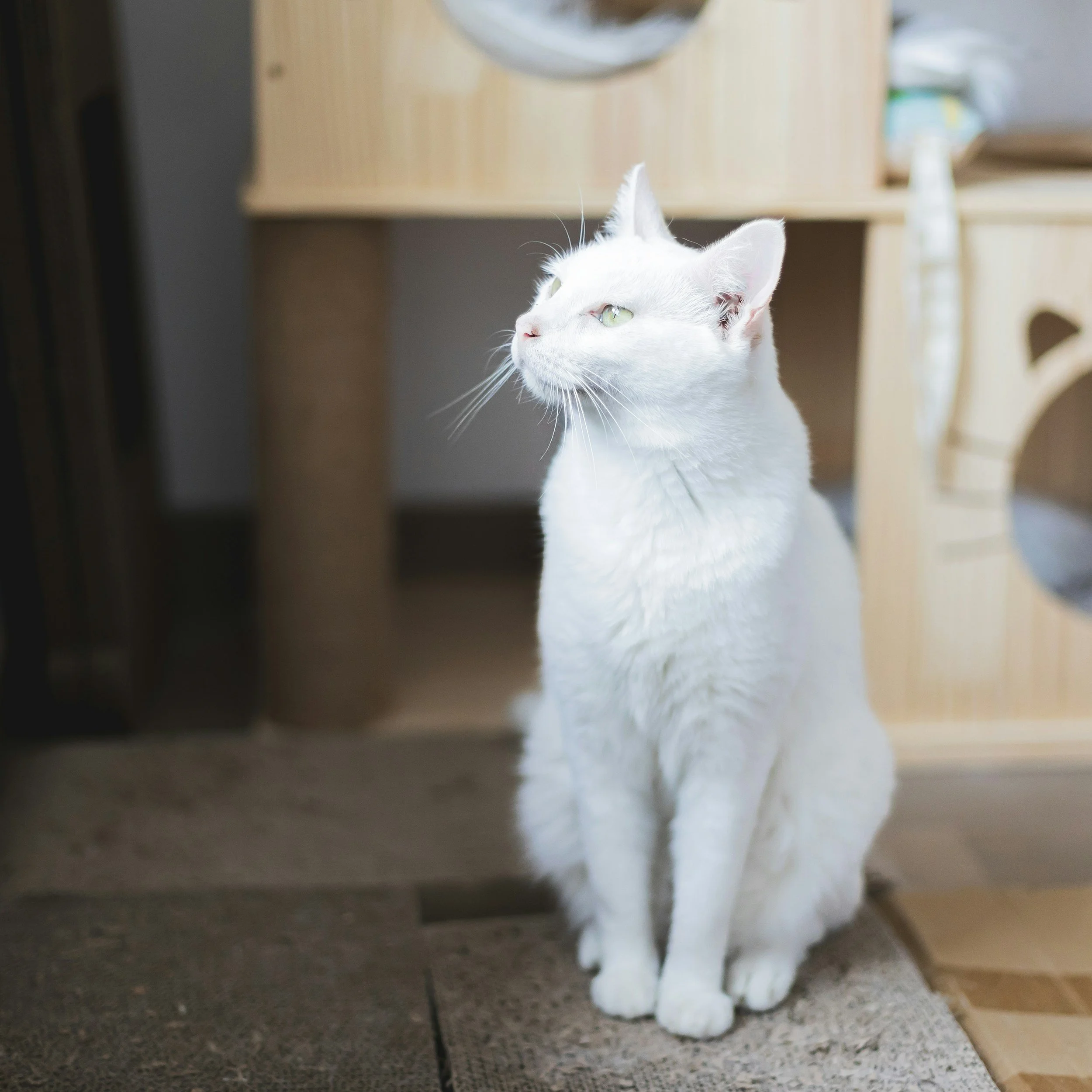
What My Cat Taught Me About Fight Mode (and how it relates to your own nervous system)
My cat Luna spotted another cat on our walk the other day. In an instant, every muscle in her body went rigid. Her tail puffed. Her pupils blew wide open. She was completely activated — ready to defend, ready to attack, fully consumed by one thing: the threat outside the glass.
To keep them both safe, I tried to redirect her. I went to pick her up so we could turn around, and she turned around and scratched me.
Not the other cat. Me. Her person. The one who feeds her and sleeps next to her and has never once been a threat. It wasn't personal. It was physiological. Luna wasn't mad at me — she was in fight mode, and fight mode doesn't distinguish between the source of the threat and whatever else is in the room. It just fights.
I see this exact pattern in my therapy office all the time.
Your Nervous System Doesn't Know Who Started It
When your nervous system perceives a threat — a difficult conversation, a looming deadline, a relationship rupture, a feeling of failure — it doesn't just respond to that one thing. It activates. The sympathetic nervous system floods the body with adrenaline and cortisol, priming every cell for survival. Heart rate climbs. Jaw clenches. Breath gets shallow. Muscles brace.
And here's what most people don't realize: that activation doesn't stay targeted to the only stimulus that feels like a threat.
It becomes globalized to every thing and every one around you.
Just like Luna's fight response spread to me — someone she trusts completely — your nervous system's fight activation spreads too. To your partner who texts you something neutral. To the friend who asks how you're doing. To the project you used to love. To your own body, your own thoughts, your own reflection.
You're not mad at those things. But you're in fight mode, and fight mode fights everything in range.
This is one of the central concepts I work with as a somatic therapist in Carmel-by-the-Sea. The nervous system isn't a logic machine. It's a survival machine. And it is very, very good at its job.
Fight Mode Doesn't Always Look Like Rage
One of the reasons this pattern goes unrecognized is that fight activation doesn't always look like yelling or slamming doors. In high-achieving women especially, fight mode tends to be quieter and more internal.
Irritability that seems out of proportion. Someone says something small and you feel a flash of heat that surprises even you. It wasn't about what they said. Your system was already loaded.
Defensiveness in conversations that don't require it. Your partner offers a suggestion and it lands like a criticism. Your colleague asks a question and you hear an accusation. Fight mode reads neutral input as threat.
Hypervigilance disguised as productivity. You're not relaxing. You're scanning — checking email compulsively, anticipating problems, trying to stay ahead of whatever your nervous system says is coming. This is fight energy without a clear target.
Snapping at yourself. The self-criticism, the harsh inner voice, the way you replay moments and tell yourself you should have known better — that's fight activation turned inward. Your nervous system found the most available target: you.
As an EMDR therapist serving Carmel and Monterey, I see this pattern frequently in women who have been managing a lot for a long time. The nervous system has been in fight mode for so long it's stopped feeling like a state and started feeling like a personality.
And Then There's the Other Side: Withdrawal
Here's where Luna taught me the second lesson.
When she's overwhelmed — not threatened from outside but exhausted, overstimulated, or done — she doesn't fight. She disappears. She goes under the bed or behind the couch and she does not want to be touched, seen, or engaged with at all.
The human version of this isn't always full social withdrawal. More often it's a quiet, creeping contraction. When we're activated in the direction of shutdown, we don't just pull back from the difficult thing. We pull back from most things.
The text you didn't answer isn't because you don't care about that person. The creative project you haven't touched isn't because the idea is bad. The self-care routine that fell apart isn't laziness. When your nervous system moves into a dorsal state — the shutdown branch of the autonomic system — it contracts broadly. It's not selective. Survival doesn't have time for nuance.
This shows up in ways that look like character flaws when they're actually nervous system responses: avoidance, procrastination, numbness, disconnection from things that used to matter, going through the motions. If you've ever said "I don't know why I can't make myself do anything," this is often what's happening underneath.
Why This Matters for Therapy
Understanding this changes how we approach the work.
If you're in fight mode, trying harder, reasoning with yourself, or setting more goals often backfires — because the part of your brain responsible for logic and long-term thinking has been temporarily offline since the threat response activated. You can't think your way out of a physiological state.
If you're in withdrawal, pushing yourself to engage more, do more, show up more fully tends to amplify the shutdown. The system reads pressure as another threat and contracts further.
What actually helps — and what I focus on in somatic therapy, EMDR, and ketamine-assisted psychotherapy — is working with the nervous system rather than against it. That means learning to recognize which state you're in, developing the capacity to come back to a regulated baseline, and eventually, building enough nervous system flexibility that you don't get stuck in these states for weeks at a time.
EMDR is particularly effective for the moments when fight or shutdown responses were wired in through specific experiences — a period of chronic stress, a relationship rupture, a loss, or anything that left a residue in the body. Ketamine-assisted psychotherapy can create the neuroplasticity window to do deeper reprocessing when a person has been stuck in a pattern for a long time.
If you're in Carmel, Monterey, or the surrounding Monterey Peninsula area and this is resonating, I offer in-person sessions as well as telehealth throughout California and Idaho.
You're Not Broken, Just Activated.
Luna doesn't dislike me. She was never fighting me. She was responding to a state her nervous system was already in — and I happened to be close.
The same grace applies to you. When you snapped at someone you love, pulled away from your life, or found yourself fighting things that don't deserve it — you weren't having a character failure. You were having a nervous system response.
The question isn't what's wrong with you. It's about exploring what state your system has been living in, and whether you've had enough support to finally move through it.
That's exactly the work.
Book a free consult here.