

Cats Purr, Humans Hum: The Science of Vibration and Nervous System Healing
If you've ever had a cat curl up on your chest and felt something in you physically soften — that wasn't just comfort. That was your nervous system responding to frequency.
There's science behind it. And it turns out, your body already knows how to do something remarkably similar.
Why Cats Purr (It's Not Just Contentment)
Most people assume cats purr because they're happy. But cats also purr when they're injured, frightened, or in labor. That's the first clue that purring isn't just an emotional signal — it's a physiological one.
Research published in the Journal of the Acoustical Society of America studied 44 felids — domestic cats, cheetahs, pumas, ocelots, and servals — and found that every single one produced frequencies between 25 and 150 Hz. What's significant about that range? Those are the same frequencies used clinically to promote bone growth, reduce inflammation, support wound healing, and improve joint mobility. Cats appear to be using vibration to regulate and repair their own bodies — a kind of built-in somatic tool.
They purr when stressed. They purr when healing. They purr when giving birth. The purr isn't a mood — it's a mechanism.
What This Has To Do With Your Vagus Nerve
The vagus nerve is the longest cranial nerve in the body, running from your brainstem down through your heart, lungs, and gut. It's the primary highway of your parasympathetic nervous system — the system responsible for rest, digestion, connection, and felt safety.
When your vagus nerve has good tone, you can regulate more easily. You come down from stress faster. You feel more present in your body. You're more available for connection — with yourself and others.
Here's where it gets interesting: the vagus nerve is directly connected to your vocal cords and the muscles of your throat. Which means that when you hum, chant, or sing, you are mechanically stimulating your vagus nerve. You're essentially purring.
Research on humming specifically shows it can lower heart rate and blood pressure, reduce cortisol, boost oxytocin, and shift the autonomic nervous system toward parasympathetic dominance. Some studies have also measured increased heart rate variability — a key marker of vagal tone and nervous system resilience — following just five minutes of vibrational sound exposure.
Eastern healing traditions have understood this for centuries. Chanting, toning, kirtan, mantra — these aren't just spiritual practices. They are somatic ones. Western science is catching up.
The Polyvagal Lens
Through the lens of Polyvagal Theory, developed by Dr. Stephen Porges, the voice and the nervous system are intimately connected. The ventral vagal state — our state of social engagement, safety, and calm — is directly linked to the muscles of the face, throat, and middle ear. Prosodic voice, melodic sound, and rhythmic vibration all send signals of safety to a nervous system scanning for threat.
This is why a lullaby can settle an infant. Why certain music makes you feel held. Why sitting next to a purring cat can shift something in your chest before you've even registered it consciously.
Vibration communicates safety below the level of thought.
Humming as a Somatic Tool
In somatic therapy, we work with the body's own intelligence — sensation, breath, movement, and sound — as pathways into healing that talk alone can't always reach. Humming is one of the simplest and most underutilized of these tools.
You don't need training. You don't need equipment. You just need your own voice and a few minutes.
Try this: close your mouth, take a breath in, and on the exhale make a gentle, low hum. Feel where you sense it in your body — often the chest, the throat, the skull. Stay with it for five or six breaths. Notice what shifts.
For clients working through trauma, chronic stress, or a nervous system that has been running on high alert for a long time, this kind of simple somatic practice can be a surprisingly powerful entry point. It's not a cure. But it's a signal — one your body already knows how to receive.
In EMDR , we use bilateral stimulation music to help the brain process and integrate what's been frozen. In nervous system protocols like Rest and Restore, we use specifically filtered sound to retrain the autonomic nervous system toward safety. In Ketamine-Assisted Therapy, specifically selected music is the guide and container for what surfaces. Sound and vibration is a common thread through every offering I work with — because it works.
What Luna Taught Me
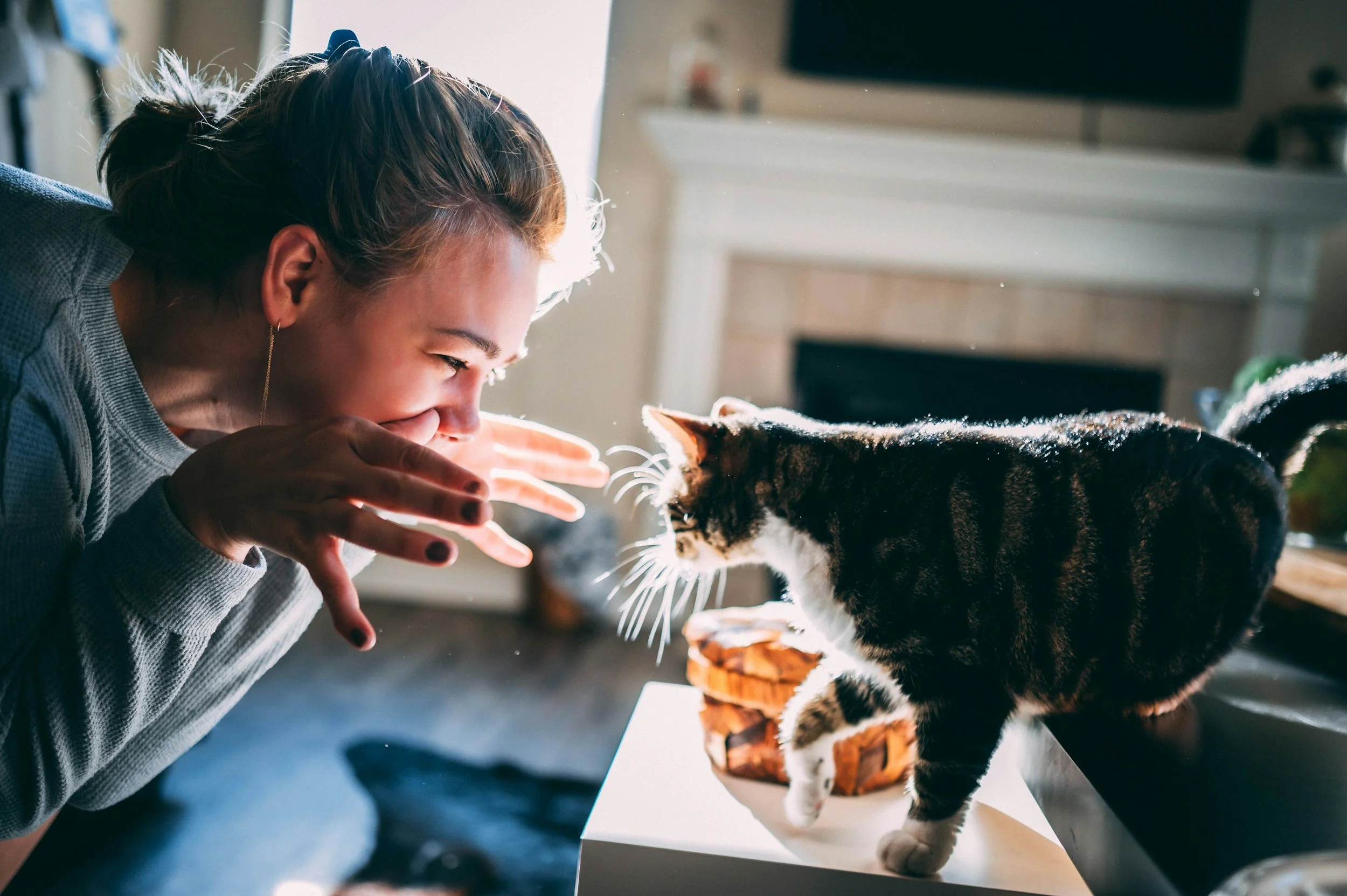
My cat Luna does this thing when I'm stressed — she finds me. She doesn't wait to be invited. She just appears, folds herself onto my lap or my chest, and starts purring.
I used to think she was seeking comfort. Now I think she's offering it — deliberately, instinctively, with a frequency her body knows how to produce and mine knows how to receive.
There's something worth sitting with in that. The idea that healing doesn't always look like hard work. Sometimes it sounds like a hum. Sometimes it feels like a small warm body on your sternum, reminding your nervous system that right now, in this moment, you are safe.
Simple Ways to Use Vibration for Nervous System Regulation
If you want to experiment with this in your own life, here are a few evidence-informed starting points:
Humming on the exhale for several breath cycles, especially after stress or before sleep. Chanting a single tone or vowel sound and feeling where it resonates in your body. Singing — even quietly, even alone — for a few minutes a day. Spending time near a purring cat (genuinely therapeutic and underrated). Sound baths or singing bowl sessions, which use external vibration to entrain the nervous system.
None of these replace therapy or medical care. But they are accessible, body-based tools that work with your nervous system's own wiring — not against it.
A Final Thought
Your body is not broken. It is intelligent. It is responsive. And it already knows how to use vibration to come back to itself — the same way a cat does, curled up and purring in the sun.
Sometimes healing sounds like that.
If you're in Carmel, Monterey, or anywhere in California and this resonates, book a free consult here.
This blog is for educational purposes only and is not a substitute for professional medical or psychological advice, diagnosis, or treatment. Ashley K. Whelan is a Licensed Professional Clinical Counselor (LPCC #11188) in California specializing in EMDR, somatic therapy, and nervous system regulation for women in Carmel-by-the-Sea and the Monterey Peninsula. Telehealth available throughout California and Idaho.